
While the emperors await
Education and existence over a geographic duality

One of these days I was talking to a senior in a bespoke asset management firm, who also happens to be living in the same building as me. We usually indulge in some small talk every time we make each other’s acquaintance, in the lift lobby or the nearby grocery store. That day we talked longer than we usually do. I was filling him in about the recent rise in students denouncing college education. “The amount of money you pay for tuition doesn’t translate into the skills you actually need at job,” I said. Suddenly, I could sense a shift in the amicable conversation we had been having a while ago. With one hand on the waist and his index finger scratching an eyebrow, he retorted, “Well at least in my field, higher education is very important.” Or your Wharton degree wouldn’t amount to anything, was what I wanted to say. He asked me how much I had to pay for my tuition. “Mm..that’s a lot,” he said nodding.
Occasionally, my mind rolls into a well of existential dread of whether my fancy finance major was really worth it. Sometimes my brother and I humour ourselves by calculating our respective return on investments of the exorbitant university experience, and then the opportunity costs of pursuing something similar had we stayed in India. To cushion the blow, we would also resort to comparing university rankings of people we knew were studying abroad and feel slightly better about ourselves. And then of course there are days when I am super thankful to make this leap of faith - a decision to move to an unknown country and build a new life there, with nothing but sheer optimism in my heart. It was difficult in the beginning, as it is supposed to be - adjusting to the new cultural norms, grappling around not knowing the language, mustering the courage to be the first one to say hi, make friends, succumbing to the exam pressure, different food, feeling alone by myself, feeling alone with strangers, with friends, dates gone wrong, some hard goodbyes. And despite all that I learnt how to be the first person to say hi, make the bestest of friends from the randomest of circumstances, started cooking, improved my English, ate a lunch with or without company, watched a lot of movies and cried during most, developed my own taste for clothes, realised I actually enjoy applying makeup, fell in love with reading again, fell out of friendships, made new friends again.
To this day, I remember a chapter from one of my hindi textbooks which talks about how bicycles ushered in a revolution among females in a remote village in Tamil Nadu. These women who had to initially traverse long distances on foot between their homes and work, could now significantly reduce the commute by learning how to cycle. I thought that it was beautiful. It taught me a very important lesson that a woman’s independence also meant being able to travel anywhere, anytime, without relying on anyone. I truly experienced that for the first time here in Hong Kong. If I decided to pull an all-nighter to study, I could choose to walk back to my dorm without depending on a male friend’s chivalry to do so. If I had a couple of drinks and decided to take the night bus back home, I could dispel my worst fears and plug in my earphones if I wanted to. I never experienced that in Gurgaon, where I had to be back by a certain hour, where each auto/cab ride meant sharing my location with my brother or a friend and staying vigilant all the time. When I was 6, mumma had me memorise papa’s mobile number lest any emergency befalls. To this day I remember it like muscle memory. Before mumma explained menstruation to me, she talked about male gaze. She instructed me if a man was touchy or handsy, where exactly to aim at. One time the lift in the building of my tuition class shut down due to power outage for 3 minutes. For what felt like an eternity, I clenched onto my pencil prepared if anything were to happen, for there was an older man beside. When I moved to Hong Kong, my pencil had the luxury to be tucked between pages of the book I was reading or simply get lost among the paraphernalia inside my bag.
Despite the independence, despite feeling an equal to any other man in this city, one thing that perpetually haunted me was that I never really enjoyed studying my major in Hong Kong. The class syllabus was too complex to understand, to the point a lot of my basics were left unclear and I felt being thrown off into these unsolvable problem questions. Most of my friends were in science or engineering courses so they couldn’t be of any help as well. As for my professors, they were some of the most learned people I had ever met, just not the best teachers. My confidence took a hit while my grades plummeted, I was swimming in loathe and self-pity. Online classes and COVID-19 further exacerbated the situation. I would idle away the hours watching sitcoms, just to have something to laugh about.
Towards the end of my third semester, the fog began to lift a bit. I realised nothing would work for me if I just gave up. So I gave it my all, even if I didn’t get the best grades. Applied for a few internships. Enrolled for a minor in art history, something which I had really wanted to do. Before this, the closest I had come to art history was reading the Da Vinci Code (and no I won’t accept any criticism against it.) I learnt about different art movements, what art had to say about the society at that time, how an artwork depicted an artists’s state of mind. I felt more aware of the world around me, more cognisant of the various social and political nuances of a country. For the first time in a long, long time, I felt like I wasn’t drowning.
My favourite class, which is no mystery to my friends, was about ancient Roman art history. There was an inexplicable and instant connection I could feel with the stories of this grandiose empire. I wondered what it would be like to actually visit these monuments and life-sized sculptures in person, to spectate physical evidence of these people who breathed and lived a few centuries ago in a different part of the world.
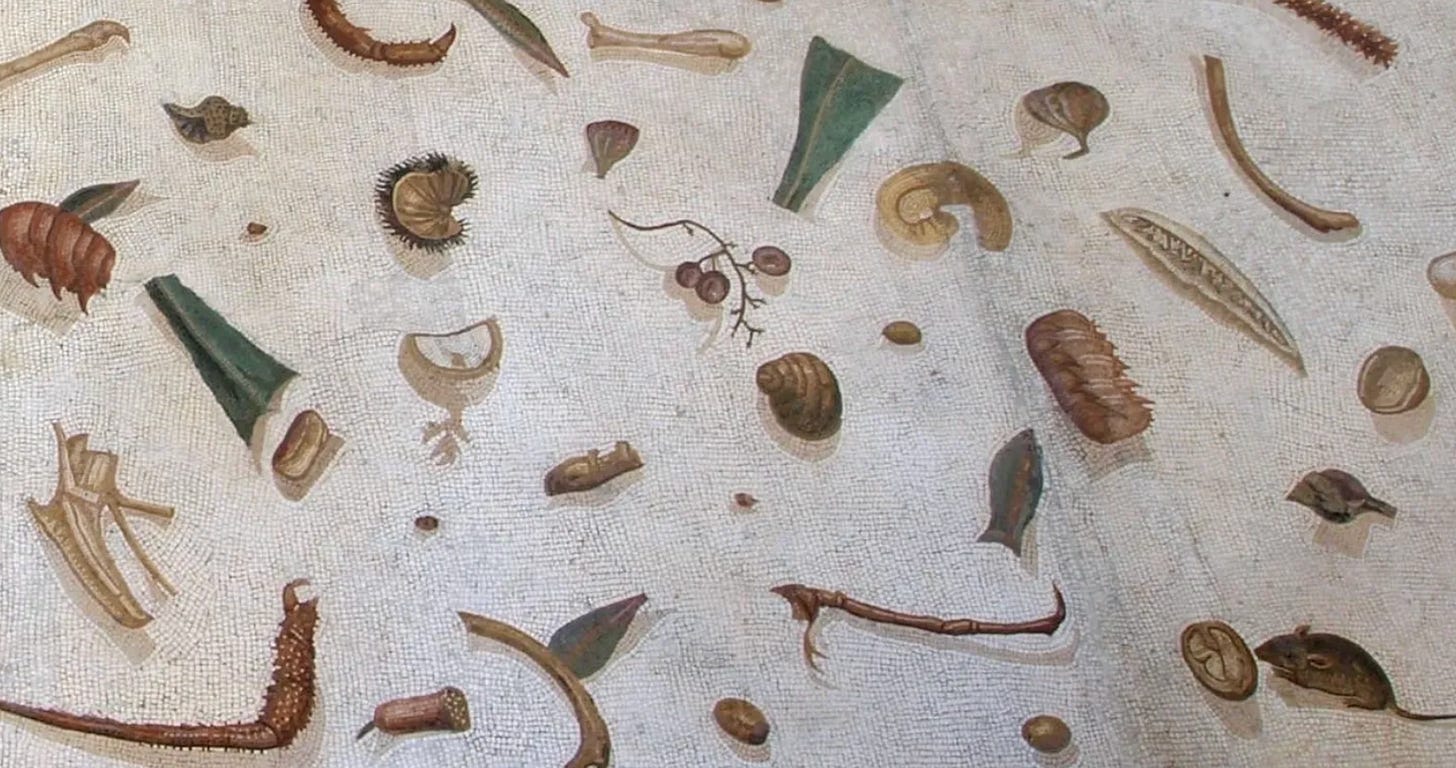
One of my favourite concepts that I learnt from this class was memento mori, echoed in the motif of discarded remnants of a banquet in Unswept Floor. A reminder of ephemerality of time, it roughly translates to “eat, drink and make merry for tomorrow you shall die.” Despite my professor’s ardent efforts to include portraiture and landmarks that reflect the common people, I couldn’t help but gravitate towards the emperors. Stories of wisdom, valour, piety, betrayal, vengeance. Different in several respects and yet united by a common desire to be remembered, to stay immortal even after death. Despite the purported mystical lineages and the entire world at their disposal, a human desire still to be recognised by people of all ranks surrounding them. Its wondrous to think that the magnanimity of these rulers survived over the years not through procreation, but the works they commissioned. Broken, pillaged, discoloured, rusted over the centuries - most of them still survive us. I read somewhere that Julius Caesar once wept because he had no notable achievements to his credit by the age of 33, while Alexander had conquered the most of the world. Little did he know how the future would unfold for him…
Like Caesar, the questions of my existence in the world and purpose in life irk me. Perhaps walking among the ruins of a fallen empire, I might find answers to some.
I love this and honestly it illustrates so well the push and pull of studying here which we talked about. It’s got its perks its merits its moments, but it’s also got all this weight and baggage, the dimming of spark and quashing of curiosity. well written, keep sharing your lovely words
This was beautiful to read, Pahu! I loved seeing your stream of consciousness and how effortlessly you connected everything. I already see ourselves walking around the streets of Rome ❤️